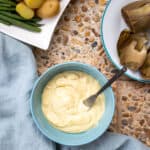
Homemade Garlic Aioli
Roasted Garlic Aioli features sweet roasted garlic mixed with homemade mayonnaise for a creamy spread or dip you'll love.
Servings: 6
Calories: 318kcal
Ingredients
- 1 head of garlic
- 2 teaspoons olive oil
- 1 egg yolk room temperature
- 1 teaspoon Dijon mustard
- 1 teaspoon lemon juice
- ½ teaspoon kosher salt divided
- Up to ¾ cup neutral oil such as vegetable oil or grapeseed oil
Instructions
- Preheat oven to 400 degrees Fahrenheit or 200 degrees Celsius.
- Cut off and discard the top ¼ of the garlic head.
- Place the rest of the garlic head on a sheet of aluminum foil and drizzle the garlic with olive oil. Sprinkle with ¼ teaspoon of kosher salt. Wrap the foil up around the garlic head, enclosing it entirely.
- Roast garlic for 45 minutes, then remove from the oven. Test whether it is ready by opening the foil, and sticking the point of a knife into a garlic clove. When the knife goes in with no resistance, it’s done. Set roasted garlic aside to cool.
- Meanwhile, to make the aioli base, whisk together egg yolk, dijon mustard, lemon juice, and salt in a small-medium bowl.
- Pour the neutral oil into a measuring cup with a spout.
- Very slowly, begin to drip the oil into the bowl with the egg mixture, whisking constantly and vigorously. You are making an emulsion, and emulsions are very tricky. At the beginning, you must literally add the oil drop by drop, making sure it is incorporated before adding more. The mixture will thicken little by little at first, and then faster and faster.
- Once you have added about ¼ cup of the oil, you can speed up the rate at which you are adding the oil. Continue to whisk constantly, taking a break if your arm tires.
- After about ½ cup has been added, you can speed up a little more until all the oil is incorporated.
- If the aioli is too thick, add a teaspoon of water at a time to loosen it up to what you desire—you will likely need to add about a tablespoon of water total.
- Squeeze the roasted garlic cloves out of their skins and into the bowl.
- Use a fork to mash them against the side of the bowl, then whisk into the mayonnaise.
- Let sit for at least 10 minutes, to allow the flavors to meld.
Notes
This recipe includes a raw egg yolk, so look for pasteurized eggs if this concerns you.
Make-Ahead Instructions: Roasted Garlic Aioli will keep up to 3-4 days in an airtight container in the refrigerator.
How to Fix a Broken Emulsion: Go too fast when adding the oil, and it’s easy to end up with either separated mayonnaise or something that looks like it’s combined but is much thinner than mayonnaise is supposed to be. The good news is that you can usually easily fix this with the addition of another egg yolk. Crack an egg yolk into a clean bowl, then slowly, slowly, a little at a time, whisk in the broken mayonnaise. This will usually help the emulsion to form again, and you’ll get a beautiful mayo without having to throw out your first batch.
Nutrition
Calories: 318kcal | Carbohydrates: 2g | Protein: 1g | Fat: 35g | Saturated Fat: 3g | Polyunsaturated Fat: 31g | Cholesterol: 31mg | Sodium: 201mg
