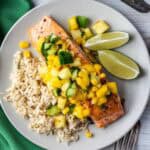
Salmon with Mango Salsa
This Salmon with Mango Salsa pairs perfectly cooked salmon with a spicy tropical salsa packed with fruit.
Servings: 4
Calories: 585kcal
Ingredients
For the Salsa
- 1 mango (¾ cup diced mango)
- 3 scallions
- ½ English cucumber
- 1 habanero pepper
- ½ cup diced pineapple
- ½ cup corn kernels
- 2 tablespoons lime juice (from about 2 limes)
- 2 tablespoons olive oil
- ½ teaspoon kosher salt
- Freshly ground black pepper
For the Salmon
- 2 ½ tablespoons olive oil divided
- 4 6-ounce center-cut salmon fillets about 1-inch thick
- Kosher salt
- Freshly ground pepper
- Lime wedges to serve
Instructions
- Slice off the two lobes of the mango, avoiding the long, flat pit on the inside. Placing the peel of the mango against the side of a glass, so that the glass goes between the mango flesh and mango peel, press down to peel mango lobe. Repeat with the other mango lobe, then slice the flesh into small cubes.
- Use a paring knife to cut around the remaining mango pit to remove any other flesh that can be added to the salsa. You should have about ¾ cup of diced mango.
- Cut scallions into thin slices.
- Cut cucumber into small dice—you should have about 1 cup total.
- Using plastic gloves, carefully cut out stem and seeds from habanero pepper, then chop very finely.
- Combine chopped mango, scallions, cucumber, ½ of the chopped habanero pepper, pineapple, and corn in a medium bowl, and stir.
- Add lime juice and olive oil.
- Stir in salt, and season to taste with pepper.
- If you want a spicier salsa, add more of the remaining chopped habanero pepper.
- Preheat oven to 350° Fahrenheit.
- Drizzle 1 ½ tablespoons of olive oil over salmon fillets and use your fingers to spread over the tops of the fillets. Then sprinkle salt and pepper evenly over the tops of the fillets, and rub in gently.
- Heat a large ovenproof nonstick skillet on a medium-high setting with the remaining tablespoon of oil.
- When pan is hot, add salmon flesh-side down. Sear for 2-3 minutes, until the top is nicely browned, then turn fillets right-side up.
- Place skillet in the oven and bake for 7-8 minutes, until just done. Test that the salmon is ready by seeing whether the salmon breaks apart into large flakes when poked with a fork, or whether it is still too raw on the inside.
- Serve salmon fillets topped with a big spoonful of mango habanero salsa, and lime wedges on the side (optional).
Notes
Note that cooking salmon well takes practice—different types of salmon will take longer or shorter to cook. Wild-caught, less fatty salmon fillets will cook more quickly, especially if they are thinner. In general, you want to bake salmon for 8-10 min for every inch of thickness of the fillet. You can also use the meat thermometer to measure the internal temperature of the salmon—I prefer mine medium-rare, at around 125-130° Fahrenheit.
A well-seasoned cast-iron skillet would also work very well for this recipe. But if you don’t have a skillet that is oven-safe, sear the salmon on your skillet, then transfer to a baking dish coated with cooking spray or foil-lined baking sheet to put in the oven.
If you want to use fresh corn instead of canned or frozen corn in your fresh mango salsa, trim an ear of corn by cutting off the top leaves and pulling off a couple of the outermost layers. Cook corn in microwave on high for 4 minutes. Let corn cool for a few minutes, then peel and cut the kernels off and into a large bowl. Add to salsa.
Nutrition
Calories: 585kcal | Carbohydrates: 25g | Protein: 40g | Fat: 37g | Saturated Fat: 6g | Polyunsaturated Fat: 28g | Cholesterol: 107mg | Sodium: 345mg | Fiber: 3g | Sugar: 16g
